

(For Illustrative Purposes Only)
People often say that an Englishman named Thomas Rawlinson made the modern kilt in the 1700s, but this isn’t completely true.
Although the English industrialist Rawlinson is generally attributed with inventing the fitted short kilt, it is well documented that kilts in some form were in use in Scotland long before him.
The fact is that the kilt was already being worn in Scotland centuries before Rawlinson ever came across it, so it is inaccurate to say that he was responsible for inventing the kilt.
His sway might have helped popularise one particular style, but the garment itself has deep Scottish roots that cannot be traced to one man, particularly one from outside the country.
This is a controversial issue because it dispels a beloved myth and begs the question of what is known about the “history” of the kilt.
By understanding the origins of the kilt, we can appreciate the rich cultural tapestry of Scotland, rather than reducing its diversity to one single story of invention.
Origins and Invention of the Kilt
Historical Background and Early Forms
The kilts, when they first emerged, consisted of long pieces of cloth that were wrapped around the body and were worn in the Scottish Highlands in the 16th century or earlier.
This earlier version, which supposedly preceded the separate garments, is the great kilt or féileadh mór, a full-length garment whose heavy plaid was pleated and belted at the waist.
The contemporary kilt was developed in the 18th century, and the process of converting it to take its modern form was in the 19th century.
It was easier and better for the kind of everyday things they had to do.
This practical shape helped to preserve Highland traditions following the 1745 Jacobite rebellion, during which many Gaelic Highland traditions were outlawed.
Debunking the Englishman Myth
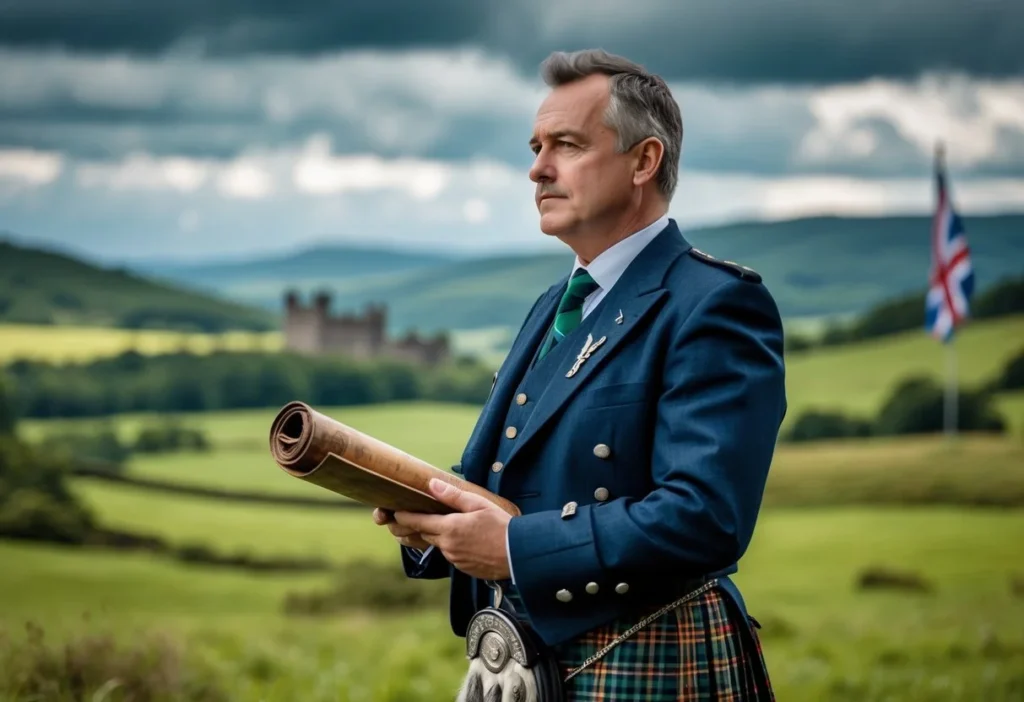
(For Illustrative Purposes Only)
Some trace the origin of the modern kilt to the 18th-century English industrialist Thomas Rawlinson.
He is said to have adapted the traditional outfit for workers near ironworks in the Highlands, the kilt being cut shorter to remove the risk of injury from fire or machinery.
But most historians regard this assertion as a myth or hyperbole. The origin of the little kilt-like garment was something that came about naturally from previous styles.
Sure, Rawlinson might have helped popularise or design it, but the kilt is 100 per cent Scottish.
The common story of an Englishman being credited with “inventing” the kilt is frequently cited but not strongly recorded in historical evidence.
Cultural Significance and Highland Identity
Kilts are loaded with cultural significance when it comes to Scotland. More than just a garment, they represent Highland identity, clan lineage and defiance of oppression.
A kilt keeps you connected with where you come from and where you’ve come from.
The kilt gained further international recognition in the military regiments and through mainstream culture.
Rituals, including the Highland Games, weddings and formal events, keep the kilt respectable. Its role as a cultural symbol is greater than any specific claim as to its maker, which makes it a living symbol of Scotland’s past, present and future.
English Influence and Modern Interpretations

(For Illustrative Purposes Only)
Kilts and Englishmen: Wearing Traditions
Whether an Englishman can wear a kilt, whether he can or not, depends very much on social and cultural context.
The kilt is traditionally associated with Scottish clans; each pattern, or tartan, represents a family. Englishmen can put on a kilt, but what is an Englishman’s tartan?
The answer varies. Some wear district or universal tartans with no clan affiliation, and others wear clan tartans if they belong to a Scottish clan or have Scottish ancestry.
English wearers often wear non-clan tartans to prevent offending or upsetting anyone.
Contemporary Kilt Fashion and 2020 Trends
With a denying, 2020 and onwards have brought in a blend of traditional and modern in terms of fashion when it comes to kilts.
Designers now create an array of fabrics, colours and tartans to attract a wider market, which includes English people. Kilts are getting more use, now worn to music festivals and weddings and even casually outside Scotland.
Custom and gender-neutral kilts have also seen a surge in popularity in 2020, mirroring shifting social attitudes and bringing the garment into the mainstream.
Englishmen and everyone else can find styles that fit our current taste without betraying their heritage.
Frequently Asked Questions
Who is given credit for making the kilt?
No one person is credited with making the kilt. Some people think that Thomas Rawlinson, an English businessman from the 18th century, had something to do with the modern small kilt, but this is still up for debate. There were earlier versions of the kilt that were around long before Rawlinson.
Where did the traditional Scottish kilt come from?
The belted plaid, also known as the great kilt, was the beginning of the traditional Scottish kilt. This was a big piece of cloth that was wrapped around the body and held in place with a belt. In the Scottish Highlands, it goes back at least to the 16th century.
Why did Scots wear kilts instead of trousers?
The kilt was useful for living in the Highlands. It lets people move around freely and can be changed for the weather. Highlanders didn’t wear trousers as often in the past, partly because of the weather and the land.
Is the kilt more of a cultural symbol of Scotland than of Ireland?
Yes, the kilt is very much a part of Scottish culture. Tartan patterns can be found in other cultures, but the kilt itself is Scottish and is a well-known symbol of the country.
Before kilts, what kind of clothes did the Scots wear?
Before the kilt, Highlanders wore the belted plaid, a large wrapped cloth used for warmth and protection. Cloaks and tunics made of wool and linen were other types of clothing.