
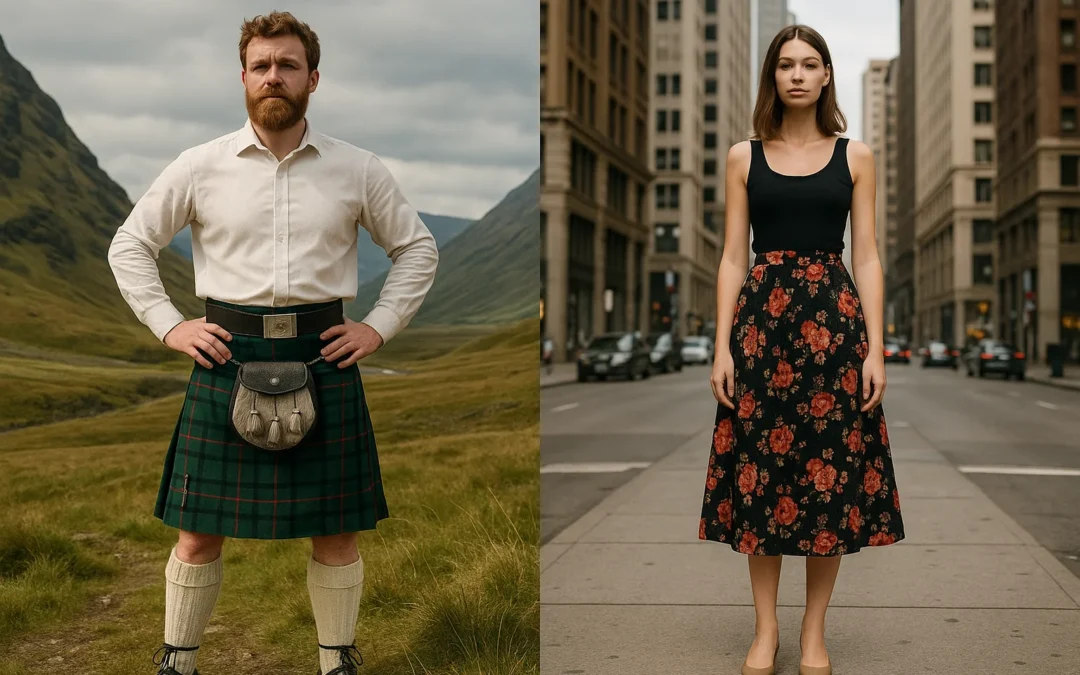
(For Illustrative Purposes Only)
(Hint: One is a fashion choice. The other is a centuries-old legacy.)
We all know that the kilt evokes differing sentiments from people across the globe. For a first-time observer, it might pass off as a fancy skirt tailored for men.
This is reasonable given that both garments envelop the lower body, have variants that are knee-high, and come in all shapes and sizes.
You, however, run the risk of inciting a passionate speech or a contagious fit of laughter by posing such a query to a Scot.
In any case, let’s analyse the sought-after differences between a kilt and a skirt.
We will begin answering this question in a manner that is polite and lighthearted, yet informative, because the matter at hand goes beyond mere clothing. It delves into one’s culture, history, customs, and citizenship.
Skirt vs. Kilt—A Global vs Cultural Garment
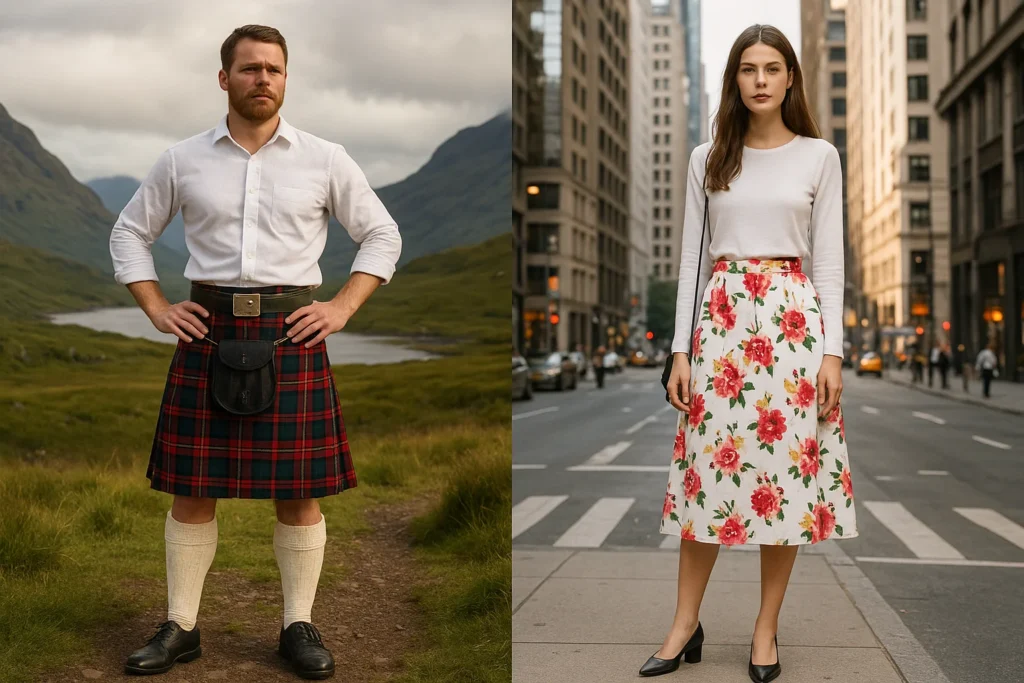
(For Illustrative Purposes Only)
Before we get into the details, here’s the short version:
A skirt is defined as an article of clothing that encircles the waist and descends the length of the legs. Skirts considerably vary in form; they can be short, long, pleated, tight, flared, formal, or casual.
Unlike skirts, a kilt is a very specific traditional garment from Scotland. It’s usually a men’s garment, frequently crafted from tartan-patterned wool.
To grasp the contrast between a kilt and a skirt, one needs to analyse history, structure, purpose, and the cultural significance.
A Quick History of the Kilt
The modern kilt originated from the “great kilt” of the Highland Scots in the 16th century. It was an outer garment that encompassed the whole body. It became easier to wear and was eventually transformed into the ‘small kilt,’ which is the version we know today.
Kilts were not just articles of dressing. They represented fabric pride, military tattoo, relative domestic patriotism, and most importantly clan association.
Even when the British administration prohibited the wearing of Highland dress during the period after the Jacobite uprisings, the kilt served as a means of identity and resistance.
Therefore, if one were to pose the question “What is a Scottish skirt called?” the correct response would be a kilt; however, it transcends a ‘skirt’ in its meanings.
Kilt vs Skirt – Side-by-Side Comparison:
| Feature | Kilt | Skirt |
| Origin | Scotland | Global |
| Cultural Significance | Deep – national pride, military, clan identity | Fashion-driven, casual or formal |
| Worn By (Traditionally) | Men (especially in Scottish and Celtic cultures) | Women (traditionally), now all genders |
| Design | Wrap-around, flat front, pleated back, tartan | Multiple cuts: A-line, pencil, circle, pleated, mini, etc. |
| Fastening | Leather straps, metal buckles, and kilt pins | Zippers, buttons, elastic waistbands |
| Length | Usually knee-length | Varies – mini, midi, maxi |
| Fabric | Thick wool, typically tartan | Any fabric – cotton, silk, polyester, denim, etc. |
| Occasions Worn | Ceremonial, formal events, Highland games, weddings, military dress | Daily wear, work, school, and fashion events |
| Gender Association | Masculine garment (in traditional context) | Traditionally feminine, now unisex in fashion |
| Structure | Heavy, structured, pleated garment made from a single fabric piece | Flexible design, many shapes, sometimes less structured |
So, Is a Kilt a Skirt?
Answering this question is simple: yes, but technically no when referring to history and culture.
From a purely structural point of view, a kilt can be classified under the umbrella term of “skirts” as it encircles the waist and covers parts of the thighs.
However, that is just like saying a Ferrari is a car, true, but misses the entire point.
Kilt wearers derive immense pride from their heritage, and calling a kilt a skirt fails to portray that.
A kilt is more than an outfit; it is a statement, a symbol of identity and tradition, and a reflection of centuries of culture.
Common Misconceptions Around Kilts
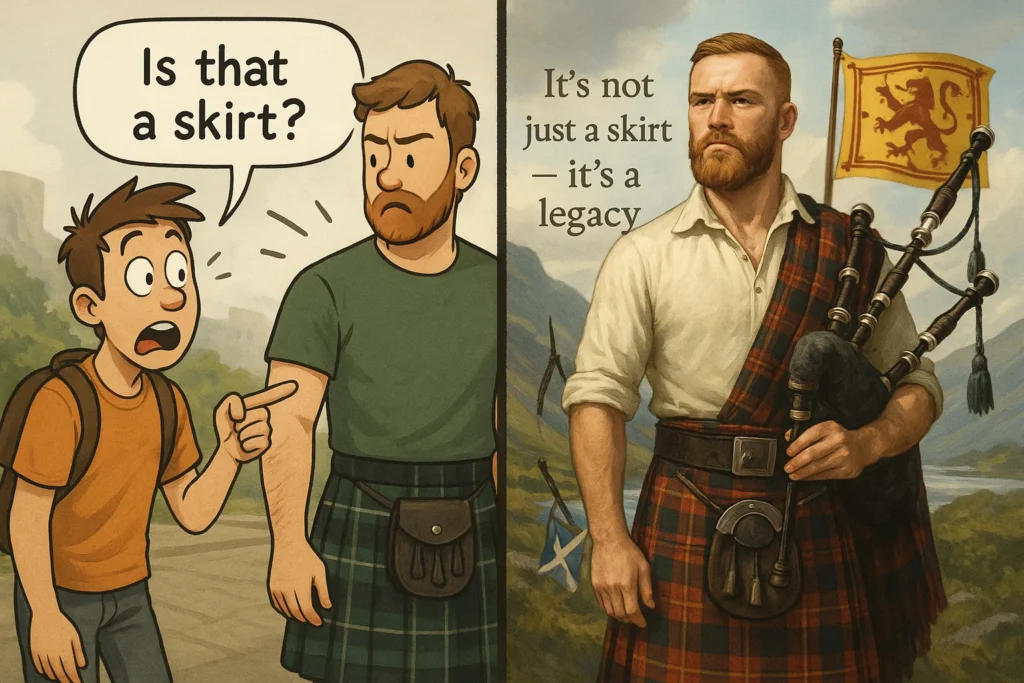
(For Illustrative Purposes Only)
-
“Are Kilts skirts for men?”
Not quite. Although they may appear the same, kilts are reknowed male ceremonial dress of scotland. Skirts might be included in modern man fashion, but that is a different story.
-
“What’s a kilt?”
Kilt is a wrap-around garment made of wool, mostly tartan, worn by men of Scotland during some formal or traditional occasions. It comes with other items as well, like a sporran (pouch) , a sgian dubh (small knife) and kilt hose(socks).
-
“Is a kilt a dress?”
No. A kilt cannot be classified as a dress. A dress is a garment that covers the torso and the lower part of the body as one piece. A kilt only covers the lower part of the body.
-
“What are Scottish skirts called?”
They’re called kilts, not “Scotland skirts” or “Scottish skirts.” In case you googled “what are the Scottish skirts called”, that’s your answer.
Kilts Today: Not Just for Scots
Kilts are worn with tremendous pride in Scotland and by Scottish descendants, and have even been popularised globally. You will spot them at:
– Traditional and modern weddings
– Military parades
– Highland games
– Rock concerts and in punk fashion
– LGBTQ+ pride parades (gender-fluid fashion embraces kilts too)
Some individuals decide to wear kilts simply because they love the aesthetic and the feel, and that is perfectly fine! Learning the history helps us appreciate what we wear, however.
Frequently Asked Questions
Q: What distinguishes a kilt from a skirt?
A kilt is a more structured piece of clothing, arranged in tart plaid patterns and worn by the Scottish people, usually by men. A skirt is a more general garment type worn by all people across the globe in several different ways.
Q: Why do people say kilts aren’t skirts?
Because on the outside, they may look the same, but the cultural values, decorations, homelands, and purpose differ. It’s not only about appearance. It’s more about its connotation.
Q: In everyday life, what is the difference between a skirt and a kilt?
Skirts have more of a place in casual and everyday life. On the other hand, kilts are typically reserved for special/formal ones, unless as part of a uniform (military bands, etc).
Q: Are there women’s kilts?
Of course, women can (and do) wear `kilts`. There are also kilted skirts and modern kilt versions made specifically for girls, particularly during Scottish functions.
Q: What does “kilt adalah” mean?
It’s the indonesian or malay translation of “kilt is….” Many look it up so that they would know the meaning of kilts in other languages.
Final Thoughts
Whether you are putting on a pencil skirt for a meeting or a full kilt for a wedding, each piece of clothing has its purpose.
But the distinction between kilt and skirt extends further than just the material used; it also encompasses origin, meaning, as well as identity.
So the next time a person without any intention of making a joke asks, “What’s the difference between a skirt and a kilt?” The only response you should give is: