
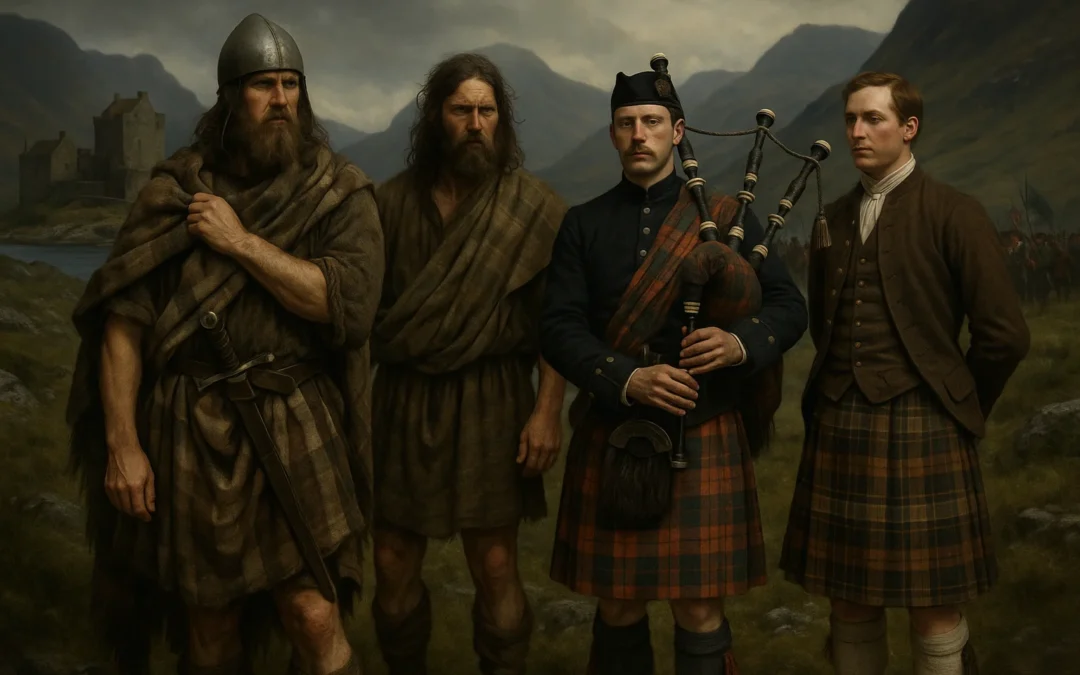
(For Illustrative Purposes Only)
Representing rich cultural traditions, kilts are symbolic garments with deep Celtic roots. One version is closely associated with Highland clans and centuries-old history, the other is a modern revival often linked to national pride.
If the two styles do share similarities, however, each also displays unique tartans, accessories and cultural significance evidence of their separate heritages. Not exactly. Both Scotland and Ireland have strong traditions for wearing the kilt, but the details the history, the tartans, when it’s worn are quite different.
Scottish kilts are old, with roots in Highland clans and hundreds of years-old traditions.
Irish kilts, however, are something of a modern revival, typically at least somewhat connected to Irish nationalism and culture as opposed to family lineage.
History of kilts:
Kilts have a rich history, but the origins of the kilt differ depending on whether you are looking at them from a Scottish or an Irish perspective.
Scottish Kilts:

(For Illustrative Purposes Only)
The history of kilts in Scotland dates back to at least the 1600s when men wore a full-length garment, or the so-called “great kilt,” known as a féileadh mòr, which was popular with Highland clansmen. This historic kilt wasn’t merely for appearances; it was a utility garment, providing warmth in the rugged landscape, and even used as a blanket at night.
From the Middle Ages onward, the traditional kilts developed into the shorter, tailored design that we know now. The origin of the kilt in Scotland is intimately linked to clan and family, and tartans are worn in remembrance of clans or families representing different families and regions.
However, after the Jacobite Rising of 1745, the kilt’s history would change when they were banned for several decades by the British government, at which point kilts were intensely connected to Scottish resistance and heritage.
Irish Kilts:

(For Illustrative Purposes Only)
Ireland’s kilt is slightly different. Kilts weren’t traditionally worn as everyday clothing like they were in Scotland. The history of the kilt in Ireland, in contrast, is more tied to nationalism and cultural pride.
In the early 20th century, Irish nationalists adopted traditional kilts from those in Scotland. Organisations such as the Gaelic League encouraged their adoption, but it was more common to see solid-coloured kilts worn by Irish nationalists than the colourful tartans of Scotland, saffron or green being the most popular colours worn.
Though kilts didn’t originate in Ireland quite as early as they did in Scotland, they have widely become a source of Irish cultural pride (think: pipe bands and ceremonial events). Although both Scottish and Irish kilts are derived from a common Celtic heritage, their development and significance have diverged over time, resulting in the kilt as a unique emblem of each of their cultures.
What is Tartan:
Tartan is a patterned fabric with crisscrossing horizontal and vertical bands of multiple colours. It is traditionally associated with Scottish heritage and represents clans, regions, and cultural identity. Tartans are woven from wool and have a distinct grid-like structure.
Tartan was traditionally a checkered or plaid design formed by weaving together coloured threads in a crosshatch pattern. Every tartan pattern is distinct, and in Scotland, it readily connects with p jo particular clans, ancestry, or regions. But the Irish tartan has a distinct history and significance.
Irish family tartan is not tied to a surname or a bloodline like the Scottish tartan, although Scottish clan tartan is associated with counties rather than clans.)
This allows Irish descendants to associate with a tartan based on their ancestral homeland as opposed to a specific family name.
Kilts vs Tartan: What’s the Difference?
It’s a question we hear often: What is the difference between a kilt and a tartan? In other words, a kilt is a type of clothing and tartan is a type of fabric used to make many of those kilts. However, not all kilts have a tartan pattern available; there are also non-tartan kilts, which are typically solid-coloured, as in the case of Irish tradition.
For example, whereas Scottish designs created multi-coloured plaids, Irish pride tartan kilts are more commonly saffron, green, or blue.
These kilts, in solid colours, became a symbol of cultural pride for Irish nationalists in the early 20th century, less heavily patterned than their Scottish counterparts
The Role of Tartan in Celtic Heritage:
Although Celtic tartan and kilts are a significant part of Scottish and Irish heritage, they have different cultural meanings.
Tartans have been worn in Scotland for hundreds of years and used to be a way of expressing loyalty to a specific clan. Eventually, they formalised family representations, so each clan would have a registered design.
Irish tartan, by contrast, relates less to clan loyalty than it does to geography. Irish tartans are proudly worn today at cultural events, parades, and festivals to celebrate Irish heritage, often regardless of direct family heritage.
That wears either an authentic Scottish tartan kilt or an Irish family tartan pattern; both scream a strong link to Celtic heritage and pride.
Kilt Accessories:
There would even be accessories available for the kilt. These accessories are both functional and rooted in the ancestry of Scotland and Ireland. Practical items: kilt pin, sporran, kilt belt, ghillie brogues, flashes, etc., keep the kilt from blowing up in a gale and allow one to carry one’s personal effects.
But they also have rich symbolic meanings Scottish accessories often stress clan identity, while Irish accessories emphasise national pride.
Kilt accessories help to tie the outfit together, but they are also symbolic embodiments of culture, identity, and pride.
Kilt Pin: A Symbol of Tradition:
The kilt pin is a true mark of the traditional kilt set, whether it is a Scottish or Irish kilt set. It’s functional and also ornamental, holding the apron of the kilt in place and
Keep it from blowing in the wind, which is especially important when you are outdoors in the rugged highlands or the Irish countryside.
- Scottish Kilt Pin: Usually bigger and more decorative, the Scottish Kilt pin usually features family crests, clan symbols, or Scottish thistles. They are a symbol of Scottish identity and clan loyalty.
- Irish Kilt Pin: Kilt pins, Irish kilt pins to be specific, are usually smaller with a Celtic cross, shamrock or harp symbol. Although they are associated with Irish heritage and national pride, they are not connected to a particular family or clan.
Selecting the appropriate kilt pin for either tradition goes beyond just a sense of style; it also represents a connection to cultural identity that ties you back to your roots.
Sporran: Functionality Meets Fashion
Whether it is a Scottish kilt or an Irish kilt, A sporran remains an essential accessory in both, but the design of the sporran can be quite varied. Traditionally, sporrans are utilised to store personal effects, as there are no pockets in kilts.
- Scottish Sporran: The largest and most decorative, the Scottish sporran is the badge of Highland tradition. Dress sporrans are usually fur or leather with embellished silver mounts for formals and even weddings, and ceremonial events.
- Irish Sporran: A functional and traditional sporran, often more modest in design. It’s more petite, crafted from leather or fur, and usually paired with a modern Irish kilt at casual events and cultural celebrations.
Kilt Belt & Buckle: The Art of Scottish & Irish Style
The kilt belt and buckle are worn around the waist to keep the kilt in place, completing the formal appearance of the outfit.
- Kilt Belt & Buckle: This is made from a piece of wide leather, and the buckle is customarily large and elaborated and often contains Celtic designs such as thistles or family crests.
- The buckle typically indicates the wearer’s Scottish heritage or clan connection. That makes a big difference in making your look more put together.
- Irish Kilt Belt & Buckle: The Irish kilt belt has the same purpose, but it is often narrower and less decorative. (Rather than tribal identity, the buckle may sport such Irish symbols as the harp, shamrock or Celtic knots, stressing Irish pride over tribal identity.)
These attachments serve functional purposes while offering glimpses into the hereditary connections of the wearer, with the Scottish kilt leaning more toward a clan emphasis while the Irish kilt points toward national pride.
Kilt Hose: Tying Tradition Together
Traditional kilt hose consists of woollen knee-high socks that should be paired with Scottish and Irish kilts for completion. The socks complete the traditional outfit appearance while protecting from weather conditions, primarily in Highland and Irish weather conditions.
- Scottish Kilt Hose: Hailing from Scotland, kilt hose are typically worn in neutral colours, including black, white, or grey and can be paired with
flashes bright, coloured bands designed to hold the socks up. The flash frequently coordinates with the kilt’s tartan, creating a unified appearance.
- Irish Kilt Hose: Apart from serving a similar purpose, Irish kilt hose are typically much less decorative. Green, cream, and grey are typical colours, following that of the Irish national colours. Flashes are typically much less decorative, but still serve the same purpose: To keep the kilt hose in place during motion.
For both hoses, the traditional look is enhanced with practical and comfortable clothes.
Ghillie Brogues: Footwear for Celtic Wear
The traditional footwear known as a ghillie brogue carries significant origins which extend throughout Scotland and Ireland. The shoes include lengthy footlaces that build an original criss-cross support system around the ankle.
- Scottish Ghillie Brogues: Black leather makes up Scottish Ghillie Brogues, which serve outdoor activities and Highland sports functions. The ankles get wrapped securely by flexible laces to allow movement. This special lacing configuration stands out in these shoes because they frequently use leather soles to provide better traction.
- Irish Ghillie Brogues: These follow the Irish and Scottish design standards yet include refined elements such as Celtic motifs and extra decorative touches. These footwear pieces exist for Irish dancing requirements because they deliver essential stability during intricate foot movements while preserving Irish traditions in appearance.
People associate the ghillie brogue with traditional Scottish and Irish roots because it continues the traditional look while offering contemporary styling choices.
Flashes: A Touch of Color and Meaning
The bright-coloured knee bands called flashes function to stop the kilt hose from sliding down through their attachment to the knee.
- Scottish Flashes: The application of flashes on Scottish kilts follows directly from the tartan and clan heritage of the user. Flashes bring flashes of bright colour, which help unite different elements of an outfit. These accessories function to match the colours of the kilt or to coordinate with the kilt pin, together with other accessories.
- Irish flashes serve functional purposes above all else because they abstain from adding elaborate trim or extensive decoration like what Scottish kilts display. Green flashes are a well-liked element in Irish kilts because they represent national pride alongside Irish identity.
The flash serves as a useful decorative element that enhances fashion appeal through additional style without affecting the basic traditional appearance of a kilt dress.
Plaid Brooch or Pin: A Celtic Tradition
A plaid brooch or pin serves to secure the sash or plaid in the Scottish kilts as well as the Irish kilts.
- Scottish Plaid Brooch: tends to be bigger and decorated elaborately with clan emblems, family insignia or Celtic interlacing patterns. The plaid brooch simultaneously positions itself to secure the garment folds as well as to maintain the overall neat arrangement of the attire.
- Irish plaid brooches present a smaller style with Irish national signs such as Celtic crosses or harps, while performing the same practical holding role as other brooches but with simpler artwork.
Through its use as a symbol of Celtic heritage, the plaid brooch fulfils both practical and cultural purposes.
Comparison Table:
| Features | Scottish Kilts | Irish Kilts |
| History | Dating back to the 1600s, tied to Highland clans and Scottish heritage. | A modern revival in the 20th century, linked to Irish nationalism and pride. |
| Tartan pattern | Traditional, representing specific clans or regions. | Not as clan-specific, often solid-coloured (saffron, green). |
| Uasge | Worn for formal occasions like weddings, Highland games, and ceilidhs. | Worn for Irish cultural events, St. Patrick’s Day, and parades. |
| Accessories | Kilt pin (family crests, thistles), sporran (fur or leather), ghillie brogues. | Kilt pin (shamrocks, Celtic crosses), sporran (leather or fur), ghillie brogues. |
| Cultrul Significance | Strong association with clan identity, heritage, and resistance. | Emphasis on national pride and cultural revival. |
| Kilt Bely & Buckle | Often larger and decorated with Celtic or family symbols. | Narrower, often featuring Irish symbols like the shamrock or harp. |
| Tartan Design | Each tartan is unique to a clan or region. | Irish tartans are less clan-specific, often related to geography. |
| Footwear | Ghillie brogues with leather soles and flexible lacing for movement. | Ghillie brogues similar to Scottish but often more refined for Irish dancing. |
Modern Styling Tips, Usage Occasions, or Maintenance Advice:
Scottish and Irish Kilt Styling Ideas:
There are also styling options with kilts, as this is a fashion trend that not only has cultural and historical significance but can also be worn stylishly.
Below are some styling tips:
Scottish Kilt: A traditional Scottish kilt is fun to wear to formal celebrations like weddings, highland games and ceilidh types of dancing.
Add a formal jacket (Prince Charlie jacket or Argyll jacket), then wear a sporran, kilt pin, and ghillie brogues.
For more casual events, a kilt can be worn with a plain shirt or sweater.
Irish Kilt: The Irish kilt is commonly worn at cultural events like parades or festivals. For formal occasions, you can always wear the kilt with a matching waistcoat, as well as a common shirt and a kilt pin, along with other accessories like the Irish sporran.
If you want to add to the Irish national pride part of St. Patrick’s Day, subtle green or saffron tones work great in accessories.
Occasions for Wearing Kilts:
Scottish Kilt: Traditionally worn in Scotland, Scottish Kilts are a traditional formalwear accompanied by a sporran, and often worn for formal and ceremonial events such as weddings, funerals, or Highland games.
They are also worn at ceilidh dances, which revolve around traditional Scottish music and dancing.
Irish Kilt: Commonly worn at St. Pat’s celebrations, parades and Irish music festivals. These may also be worn at cultural occasions, or formal Irish celebrations, although with slightly less formality than the Scottish variant.
Final Thoughts:
Both Scottish and Irish kilts have ancestral Celtic roots, yet display distinct patterns of tartans alongside their histories, along with their specific accessories.
Family ties appear through accessories in Scottish kilts, but Irish kilts keep their design simple to represent national pride.
Both cultural identities connect to their original roots through the significant role of tartan patterns.
Kilts from Scotland and Ireland come with historical accessories that unite tradition and distinctive style to represent the ages of cultural development.
FAQs:
Q1: What is the difference between a Scottish and an Irish kilt?
Scottish kilts have a connection to clans and the use of tartan patterns, whereas Irish kilts are around national pride and are quite often in solid colours (green and saffron the colours of the Irish flag).
Q2: Is it acceptable to wear a kilt for casual events?
Kilts can be dressed down with simple shirts, but the traditional accessories are best reserved for formal occasions (think: sporrans and kilt pins).
Q3: What do men wear under their kilt?
The common accessories around this would be a sporran, kilt pin, ghillie brogues and kilt belt. Scottish accessories stress clan identity; Irish ones, national pride.
Q4: What’s tartan, and how does it relate to kilts?
Tartan is a fabric design based around crisscross lines; Scottish kilts made the connection between tartan and clans, and Irish kilts used it more to indicate geographic origins.
Q5: Are Irish and Scottish kilts worn the same?
They are worn similarly, but Scottish kilts can be more ornate while Irish kilts have less elaborate accessories, focusing more on displaying a sense of national pride.