

(For Illustrative Purposes Only)
Choosing the right sporran depends on the occasion, the type of kilt worn, and personal style.
Selecting a sporran that is too casual or too formal for the event will mute its practical storage functionality. A good sporran will match a kilt’s colour and fabric and not in any way clash with the outfit.
Ornate sporrans are paired with formal outfits, while simple leather sporrans are paired with casual outfits.
Aside from style, the size and shape of the sporran also play a role in comfort, particularly how the sporran sits on the waist belt. Understanding traditional Scottish dress and sporrans will help make sporrans a useful and integral part of a man’s formal outfit.
Understanding Sporrans and Their Purpose
A sporran is a pouch which is fastened to the front of a kilt. As a sporran is a form of pouch, it allows the wearer to carry small items.
Sporrans, like most accessories, have different varieties and styles which include different purposes and occasions.
Different Types of Sporrans for Kilts
The three primary categories of sporrans are day, semi-dress, and dress.
Day sporrans are practical and straightforward, often crafted from leather. They are best suited for casual or daily wear.
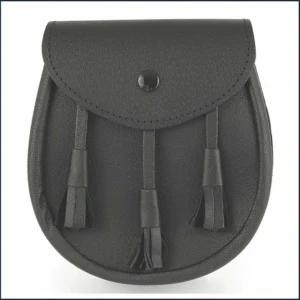
Semi-dress sporrans are classified as appropriate for informal, yet refined, occasions and feature added decoration, such as fur or metal embellishments.
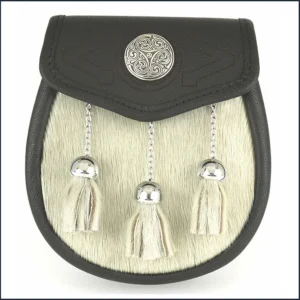
Dress sporrans are the most ornate. Used to accessorise formal occasions and ceremonies, often worn with full fur fronts, metal cantles, and tassels.

While each sporran serves a distinct function, all effortlessly blend tradition with the kilt and function as a bag.
Common Sporran Materials and Designs
Sporrans can be made from different materials, such as leather and fur, but are mostly made of fur and leather.
Leather sporrans are quite popular, as they are used for easy carrying for day and casual sporrans. Leather sporrans may be tooled with patterns or left unadorned.
More elegant sporrans, worn for semi-dress or dress occasions, are fur sporrans made of fox, badger, or seal.
Parts made of metal further the functional and aesthetic purposes of the sporrans, as they can be cantles and chains.
Materials are selected based on the occasion and personal preferences of the wearer, as creation varies from region to region.
Some designs are simple and have a plain front, and others have front plates with tassels or engraved metal embellishments, which give the design an elegant touch.
Where and When to Wear a Sporran
Different settings determine the type of sporran worn.
Day sporrans are appropriate for outdoor events and regular use.
Slightly more formal than day sporrans, semi-dress sporrans are appropriate for weddings, dinners and other smart casual events.
Overall, dress sporrans are the most formal and are worn only for ceremonies, official events, or other formal occasions.
It is essential to respect the event’s sporran etiquette and wear the correct sporran. The correct choice of a sporran enhances tradition as well as ensures practicality.
How to Choose the Right Sporran for Your Needs
Matching Your Sporran with Kilt Types and Occasions
Attending formal occasions requires a polished outfit with a full-dress kilt ensemble. To complement it, a dress sporran embellished with fur and silver detailing works best.
For everyday activities, a simple leather sporran matches utility and everyday kilts. It serves its intended purpose without over-accessorising.
For weddings and dinners, a sporran with light decorative carving and leather detailing serves suitably. These occasions are classed as semi-formal and often call for semi-formal wear.
A sporran should always match the kilt’s tartan and style; the colour and material of the sporran are equally important.
Proper Ways to Wear a Sporran and Kilt
The sporran ought to be positioned so that it is centred over the front apron of the kilt, resting approximately 3–4 inches below the waist buckle. It should also not be tightly bound to the kilt; it needs to hang freely.
Make sure the leather strap is adjusted in a way that the sporran is securely in place while allowing comfortable movement. The strap should rest on the wearer’s hip area.
The sporran’s weight is also important to consider. Dress sporrans can be worn during formal occasions, while lighter sporrans are suitable for casual occasions.
Frequently Asked Questions
What distinguishes full dress from day sporrans?
As with full dress sporrans, day sporrans retain a measure of formality, though they use leather rather than fur. These sporrans are suited for everyday use.
What are the customary contents of a sporran?
As the name suggests, a sporran has pockets, a wallet, a few coins, and a pocket watch. In the absence of pockets, the sporran serves as a small handbag.
What types of wear are sporrans traditionally classified under?
Highland dress and kilts are often accompanied by sporrans. They are commonly worn during weddings and formal ceremonies and are part of cultural attire. In more relaxed settings, a simpler sporran forms part of the casual Scottish ensemble.
In what contexts is it customary to wear a sporran?
For more formal events, a full-dress sporran featuring fur and metalwork is appropriate.
For more relaxed occasions, a simple leather sporran is the best choice. In both cases, the sporran should complement the outfit and the accompanying accessories.