

A sgian dubh is one of the traditional adornments of Scottish Highland wear.
It is a small, single-edged knife, usually fitted into the top of the sock on the right leg. It is not only a practical asset but also a culturally significant emblem.
A sgian dubh is not only practical but also serves as a symbol of one’s heritage.
The blade is often wooden and horn handled, which is compact and elegant. Though its origin was closely tied to self-defence, nowadays it serves as a ceremonial symbol of Scottish culture.
Many individuals appreciate the sgian dubh, which is worn with a kilt and accompanies the sporran and ghillie brogues.
Its use is culturally and historically significant as it links contemporary users to the Highlandian heritage.
What Is a Sgian Dubh?
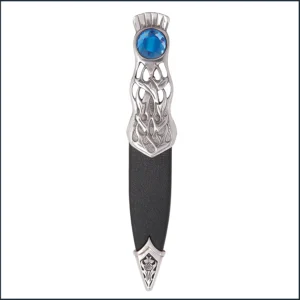
The sgian dubh represents a small traditional Scottish step knife with a definable social and cultural significance.
Other than its delicately designed features, the sgian dubh has a name that is etymologically Gaelic.
Its compactness and unique Scottish couture make it a remarkable piece of Scottish history.
Meaning and Pronunciation of Sgian Dubh
The term ‘sgian dubh’ is derived from Scottish Gaelic and is pronounced ‘skeen doo’ in phonetic approximation. The word ‘sgian’ means ‘knife’, and ‘dubh’ translates to ‘black’. Thus, its translation, ‘black knife, refers to either the knife’s colour or the fact that it was often worn discreetly.
In the past, the sgian dubh was worn as a concealed sidearm and served the function of a discreet personal defence weapon. In contemporary use, it serves primarily as a ceremonial object worn with the full Highland dress.
There are various spellings, including skean dhu, sgian-dubh, and skian duh. All refer to the same type of small Scottish knife, often called a “kilt knife” or “sock knife” due to how it is worn.
Distinctive Features of the Sgian Dubh
The sgian dubh is a single-edged knife with a sharpened straight or slightly curved blade that is anywhere between 3 and 4 inches long. Its blade is often wood, horn, or antler, sometimes carved or with decorations.
The sgian dubh is worn tucked into the stocking or sock, with one aspect protruding above the stocking. This is most commonly the case for right-handed individuals, who wear it on the right stocking. This design serves both functional and aesthetic purposes.
In contrast to the larger dirk, which is another form of a Scottish dagger, the sgian dubh is both simpler and shorter in size.
Its absence of blades and forks is a defining feature. Typically, the blade is composed of steel, and the hilt may have silver or other metal decorations.
Tradition, History and Modern Usage
Origins and Historical Significance
The sgian dubh, translated “black knife”, is of Scottish Gaelic origin from the 17th or 18th century. Possibly derived from a self-defensive small weapon or tool, the sgian dubh served a significant purpose. It was quite common, even a tradition, to carry a small knife like the sgian dubh for protection and utility in daily life.
In history, the sgian dubh was worn concealed in the sock or hose, as larger weapons were prohibited in public spaces.
Its small dimensions, alongside its discreet positioning, rendered it both functional and symbolic.
It eventually became integrated within Highland dress and linked to clan identity and heritage.
The sgian dubh also symbolised honour and the willingness to self-defend. Although the blade was kept sharpened, the dagger was more a mark of status and cultural pride than a weapon intended for earnest fighting.
How and Where to Wear a Sgian Dubh
Typically, the sgian dubh is worn concealed in the upper part of the kilt hose or sock on the right leg for right-handed individuals. This position maintains the dagger within easy reach while mostly out of sight. Left-handed users may wear it on the left leg.
It is placed in the sock and not on the belt or waistband. This practice comes from an era when swords and larger blades were carried openly. During that time, the sgian dubh served the purpose of a small, concealed weapon or tool.
Traditional and Modern Sgian Dubh Designs
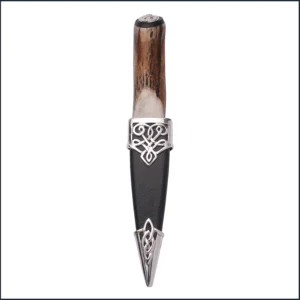
A classic sgian dubh features a compact single-edged blade measuring 3 to 4 inches long. The blade itself is usually steel and can be adorned with subtle etchings. The sgian dubh’s horn or wooden handle is often embellished with silver or metal bands engraved with intricate Celtic designs.
Contemporary designs are more varied and eclectic. Besides traditional attributes, some added more intricate metals or even coloured stones and carved handles with personal flair.
A comparison of typical features might look like this:
| Feature | Traditional | Modern |
| Blade length | 3 to 4 inches | Similar, sometimes slightly longer |
| Handle material | Wood, horn | Metal, synthetic, carved wood |
| Decoration | Minimal; Celtic or clan symbols | More colourful, personalised designs |
| Usage | Everyday carry, formal wear | Formal wear, collectors’ items |
Frequently Asked Questions
How is ‘sgian dubh’ correctly pronounced?
As phrased here, ‘sgian dubh’ is pronounced something like ‘skee-an doo’. The first word ‘sgian’ is pronounced ‘ski-an’ with a soft g not pronounced. The second word, pronounced like ‘doo’, means ‘black’ in Gaelic.
On which leg should one traditionally wear a sgian dubh?
As a tradition, the sgian dubh is worn tucked into the top of the hose, often on the right leg. It is worn just above the sock and below the knee, which makes it prominently worn and part of the Highland dress.
What purposes does a sgian dubh serve?
The sgian dubh was originally used as a small personal knife for utility and self-defence. In the modern context, the dagger serves mostly a decorative purpose, while the sociocultural implications of the dagger are still preserved.
What rights does the owner of a sgian dubh have?
The dagger isn’t a banned item and can be bought in retailers dealing with traditional Scottish attire and dagger shops. Normatively, a sgian dubh can be worn with traditional attire in Scotland, provided it is done in good faith and isn’t used as a weapon.